
Leadership asks the question every marketing team dreads. “What revenue did this content drive?”
And if you’re like most B2B marketing leaders, you either draw a blank or pull up a dashboard full of metrics that don’t answer the question. The conversation turns into friction. Budgets get questioned. Trust erodes.
Here’s the real issue. Content rarely shows up as a clean, direct line to revenue. That’s not a failure of your Marketing. It’s simply how content works.

The teams that win this conversation don’t try to prove content ROI with a single metric. They communicate how content influences revenue over time. And they use a framework to do it.
Why Content Influence Is Indirect
Content shapes decisions long before a prospect fills out a form or speaks with a salesperson. It builds familiarity, reduces perceived risk, and positions your expertise in the minds of buyers.
That influence is real, but it’s indirect. And because it’s indirect, it doesn’t show up on a neat attribution report. When leadership doesn’t understand this, content programs get cut right before they start to compound.
Expectations need to match how content actually works. That’s the gap most Marketing teams fail to close.
The TRACE Framework
TRACE is a leadership communication tool. It gives your executive team a shared model for understanding how content supports revenue over time. Each letter represents a specific type of influence content provides.
TRACE is part of a larger system called RevCo (Revenue Content Operations), a model built for operating content as a revenue-supporting system through cumulative impact.
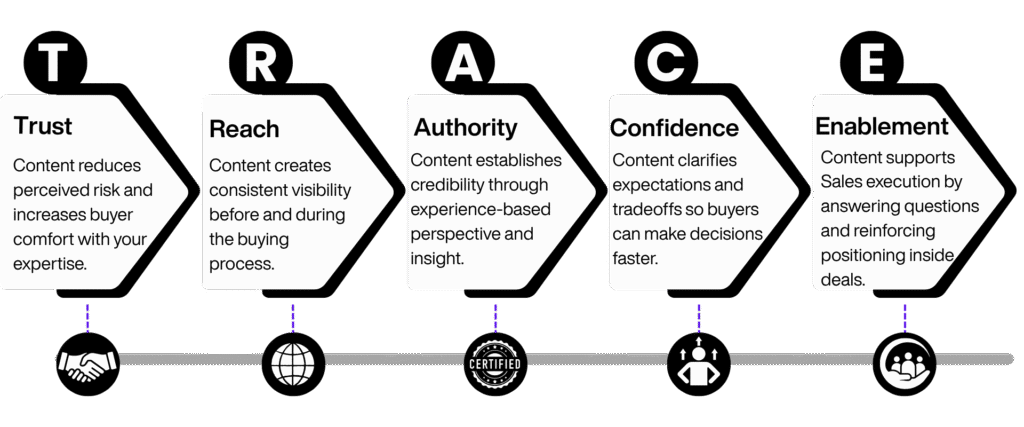
Here’s each component of the TRACE Framework:
T: Trust
Trust is the first job content does. Your content reduces perceived risk and increases buyer comfort with your expertise. When trust is missing, buyers hesitate, stall, or default to the safer option, even if your product is better.
Trust is why content works even when you can’t attribute it. It’s shaping comfort long before a conversion event ever happens.
R: Reach
Reach doesn’t mean going viral. It means your content creates consistent visibility before and during the buying process. B2B buyers don’t purchase the day they discover you. They buy after repeated exposure while they evaluate their options.
Consistency is what makes you feel familiar. And familiarity is what makes follow-up conversations easier for your Sales team.
A: Authority
Authority is the difference between being seen and being believed. When your content conveys experience-based perspective and insight, your audience decides, “These people know what they’re talking about.”
Authority makes the Sales process stronger because credibility transfers into the deal. When the market already respects your brand as an authority, the selling gets easier before Sales ever speaks.
C: Confidence
Confidence accelerates decisions. Your content clarifies expectations and trade-offs so buyers can move faster. Buyers don’t stall because they dislike your offering. They stall because they’re unsure what happens next, what it costs, and what they’re choosing between.
Ambiguity kills deals. Confidence content removes it.
E: Enablement
Enablement is where TRACE connects directly to revenue execution. Your content supports Sales by answering buyer questions, countering objections, and reinforcing your positioning while deals are being worked.
This is what keeps deals moving when buyers go quiet. This is what supports follow-ups without pressure. And this is what aligns multiple stakeholders on a buying committee.
Enablement should be planned from the beginning of your content operation, not bolted on as an afterthought.
Using TRACE to Protect Your Content Budget
Without a framework like TRACE, leadership defaults to expecting instant attribution. When content doesn’t show a direct line to revenue, confidence drops and programs get cut too early.
TRACE gives you a structured way to show how content compounds over time. Trust builds comfort. Reach builds familiarity. Authority builds credibility. Confidence removes ambiguity. Enablement supports Sales execution.
When leadership understands these five layers of influence, content becomes a fundable asset instead of an expense that’s always on the chopping block.
Activating TRACE within RevCO for Greater Revenue Impact
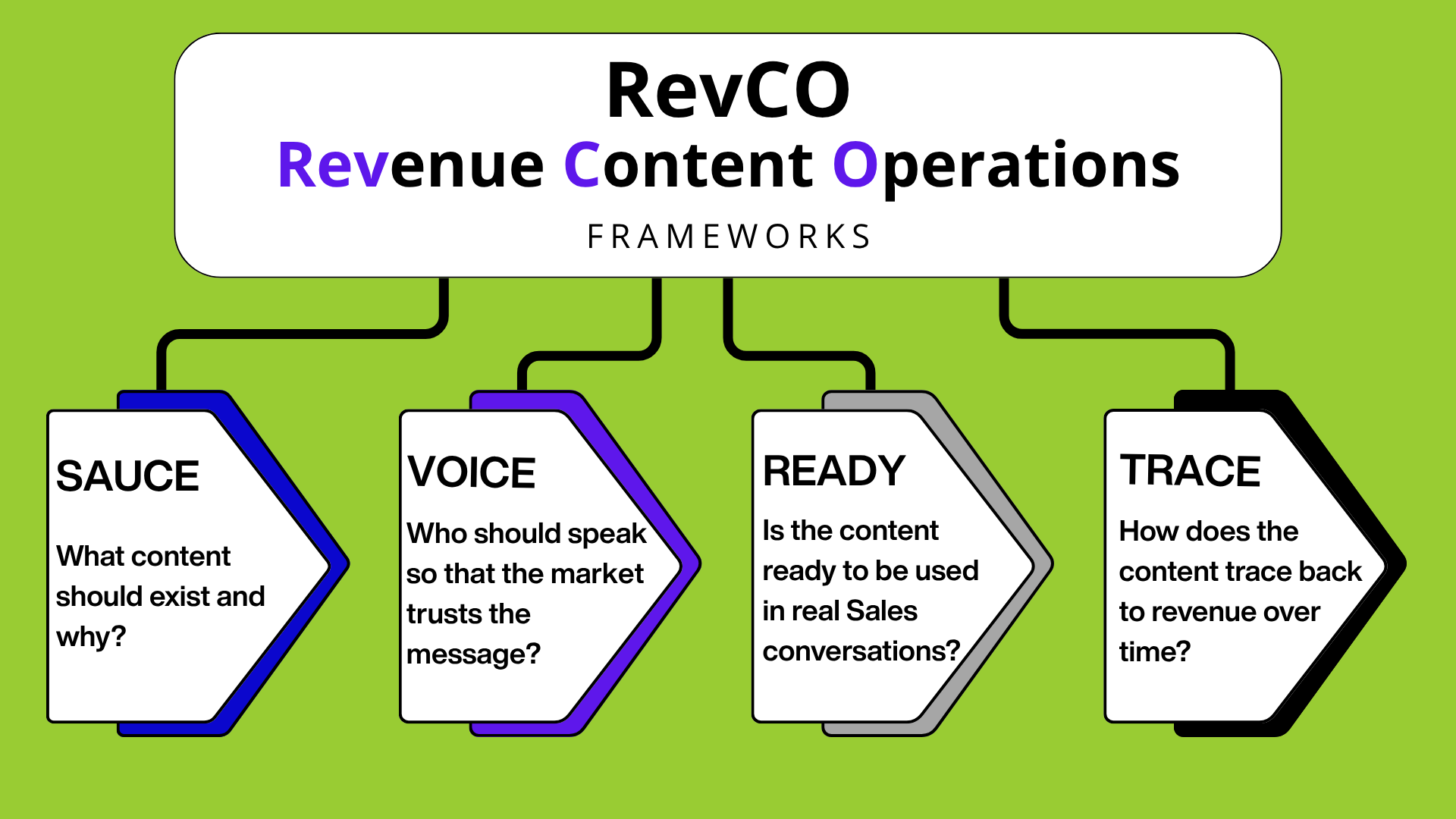
RevCO is Revenue Content Operations, and it is marketing’s revenue operating model for content. It gives marketing strategic clarity through SAUCE, authority structure through VOICE, sales usability standards through READY, and executive expectation alignment through TRACE.
Together, they move content from campaign output into revenue-aligned marketing infrastructure. If you want to go deeper into each component, check out the individual breakdown videos for SAUCE, VOICE, READY, and TRACE linked below.
Other Framework Videos:
SAUCE framework – https://youtu.be/l7AE18vNrG4
VOICE framework – https://youtu.be/0JVbNSw59h0
READY framework – https://youtu.be/JCj3ReX-Tb4
TRACE framework – https://youtu.be/tBwlKQe7IOw
If you want to keep pushing your content strategy toward ROI and business impact, learn about the other RevCo components: Sauce, Voice, and Trace. And keep building assets that are relevant, easy, answer questions, de-risk decisions, and yield momentum.
=======
About A. Lee Judge
A. Lee Judge is a Keynote Speaker on Sales and Marketing and the author of CASH: The 4 Keys to Better Sales, Smarter Marketing, and a Supercharged Revenue Machine. With 20 years of enterprise experience, A. Lee Judge is sought after by Sales and Marketing leaders and is the founder of Content Monsta, a B2B video and podcast production company. Revenue Teams book A. Lee Judge for company kickoff events, SKOs, RKOs, and executive meetings. He delivers practical frameworks that align Sales and Marketing, connect content to revenue, and drive measurable results. As a Sales and Marketing Speaker and advisor, A. Lee Judge equips teams with actions they can use right away.