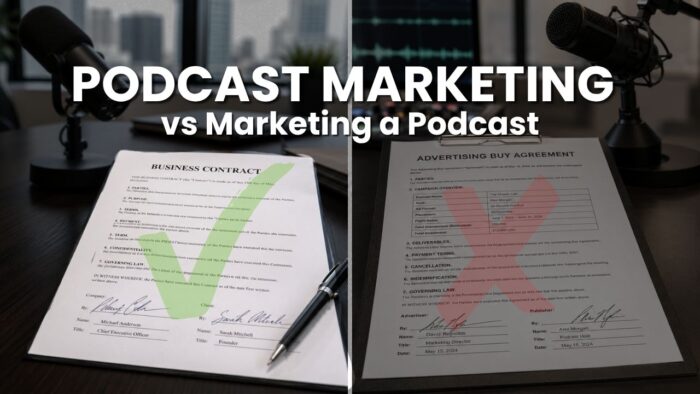
When most business leaders hear the phrase, they think it means promoting a podcast. Growing downloads. Chasing subscribers. Building a show big enough to attract sponsors.
That is one kind of podcast, and it is the wrong kind for a business. It’s time to reframe your thinking about podcasts.

Podcast marketing, the way it actually works for a B2B company, means using a podcast to do your marketing. The show is not the product you sell. The show is how you communicate with your business audience, build relationships, and bring customers closer to doing business with you.
These are two completely different models, and confusing them is where companies waste time and money.
The podcast benchmark question is a red flag
When a business approaches me for a podcast, one of the biggest red flags I hear them say is, “What are the benchmarks for a successful podcast?”
My response is that it depends on the goals for their business.
For a B2B company, the goal is not to create a famous podcast. The goal is to move their business forward.
Here is why that question is a trap. The data most people find when they research podcasting comes from a world built on advertising and sponsorships. That model depends on high downloads and fame, because downloads and fame are what you sell to advertisers. A business podcast has nothing to do with that. When you measure your show against benchmarks built for a different business model, you are measuring the wrong thing from day one.
The business conversation creates content
So what does moving the business forward actually look like?
It starts with capturing the conversation. A modern podcast always starts with video, and creating video in a conversational manner is a tremendous asset builder for a company’s content marketing.

You build a library of sales enablement tools. Sales can go out and use the videos, the video clips, and the articles created from those conversations in the sales process.
In other words, the conversation creates content. Content creates substantial ammunition for sales to use to help move deals forward.
Those conversations expose a company’s opinion and experience. They show its values and expertise. Doing a podcast lets you capture that expertise and repackage it as:
- Video content for YouTube
- Video shorts for social
- Full-length website articles and thought pieces
- One-sheets for sales
- Emails and newsletters sent during the sales process
These all move the business forward, whether the podcast has mass appeal or not. Capturing those conversations is the first win, and it creates a valuable and lasting asset for the company.
Why “video podcast” is the right starting point
Podcast was the origin. Video podcast is the starting point now.
A few reasons make video the default:
- It is much easier to capture video for a video podcast than it used to be.
- The amount of content you can create from a video podcast is far wider than audio ever allowed.
- A video podcast is more discoverable. Once it is on YouTube, you are publishing to the second largest search engine in the world, and that content also shows up in AI results. None of that was possible with audio only.
- If you have a video podcast, you can strip the audio and distribute it through Apple Podcasts and Spotify. Audio is a given, because it comes out of your original video.
There is a bonus here that most companies miss. You do not even have to publish the recordings as a series of episodes. A video podcast can simply be a way to capture video conversations to use across your website, your social channels, or YouTube.
Video is the master file. Everything else is an export.
Audio podcasting is Old School if Audio-Only
A lot of leaders still picture a podcast as two people in headphones talking into a microphone. I would like for us to eventually break away from the term podcast, because it conjures up visions of NPR or bro-casting.
What we are talking about are video shows, or expert conversations captured on video.
Companies can create full-on talk shows to discuss their industry and even their offerings. Talk show is a much more appropriate term than podcast, as long as you stay away from sounding like an infomercial.
The simplest way I describe it is this: a video podcast is a conversation among experts where your audience is privy to the conversation.
Podcast Guests – Who belongs in the guest chair?
The media model says book the biggest names you can find. The marketing model is different.
Two guest types work best for a B2B podcast:
- Well-known industry leaders, people anyone in your industry would recognize as experts.
- Your own internal leadership and expertise, from the executives down to the engineers who create the thing you sell.
The important word is industry. These are recognizable names in your industry, not in the world. Every industry has its own celebrities, even if it is industrial flooring.
Bringing in people associated with brands that are well known in your industry works too, because those brands lend expertise. You gain credibility by association. Being in the proximity of those well-known names lends credibility to your name and your company.
Why these shows fail (and it is not the audio)
When a B2B podcast does not work, the reason is usually not the audio quality or a busy calendar.
It is a strategy problem. The brand did not understand content marketing or the time frames around it. Content marketing is the long game. You do not start a content program and get results in the same month.
The other common failure is leadership not understanding how much their contribution matters. We have had a company leader or a high-level executive host the show, which is an excellent move when their calendar can sustain it. In those cases, the calendar is rarely the real blocker. The blocker is expecting results in one quarter when content marketing does not work that way.
What we actually see when a show is working is a digital footprint that keeps expanding, more content for the sales team to use, and visibility that begins to grow. A leader staring at the bottom line within 30 days will not see the swell of content assets that supports the business for months to come.
This is why, at Content Monsta, we stress the strategy part as much as the production part. We are a content marketing agency that focuses on strategy and building the business. Production is one of the means we use to do that.
You wouldn’t see sponsors for discovery calls
Here is the part that trips up even smart executives.
No (non-media) company seeks sponsorships to pay for its blog articles. No company seeks sponsorships to pay for its discovery calls. Those are functions of the business that help sell what the business sells.
A business podcast is the same thing. It is a business asset used to bring customers to the business. And it is a business asset that creates more business assets, because it is pillar content that produces other forms of content beneath it.
When a CEO asks me, “If we get big enough, could we make money from sponsors too?” my honest answer is yes, you could, and that is not what you are in business for. If you sell software, you are not trying to become an advertising agency. You sell software.
Business Podcast Fails – Not a Zoom call, not a studio
Two misconceptions sit on opposite ends of the spectrum.
Some executives think a video podcast could look like a Zoom meeting. In that case the quality, the structure, and the strategy are all poor.
Others think it requires a big studio, studio budget, lots of time, and long planning efforts. That is also wrong.
Remote video podcast production can deliver high quality with scheduling flexibility, no studio required, and a far more professional look than a conference call. Not a conference call, and not a studio session. It is a remote video production session.
The shift worth making
A video podcast is an investment in a business asset. It is an opportunity to show that your company has real people with real experience and real knowledge.
It is an asset that sells for your company 24 hours a day, seven days a week, while your customers do their own research. When your customers are curious, you want to be found in their journey to answer questions and build trust. For that to happen, your content has to be present.
A video podcast lets you create a great amount of presence in a minimal amount of time. That is business efficiency.
If reaching more customers with efficiency is something your company wants, start capturing conversational content through video.