If you’re creating content for business and not seeing results, it’s likely because you’re missing the engine behind it.
Table of contents
- What Is a Content Engine?
- Why Video Content Should Power the Content Engine
- Understanding the Content Hierarchy
- For Content Creation – Start with Format, Not Channel
- What Not Having a Content Engine Means
- How the SAUCE Framework Aligns Sales and Marketing
- When Do You Need a Content Engine?
- How to Start Building Your Content Engine
- What Changes When Your Content Engine Is Running
- Why Build a Content Engine?
What Is a Content Engine?
A content engine is a system that goes beyond campaigns or a set of posts. It is how content marketing becomes content production that consistently, strategically, and with clear outcomes supports business growth.
A. Lee Judge of Content Monsta defines a content engine as “a planned and purposeful way of using content to drive a business purpose. It’s an organized effort to ensure that content created for business is designed to support revenue objectives.”
That means no more random acts of marketing. Every asset has a reason to exist and a role to play.
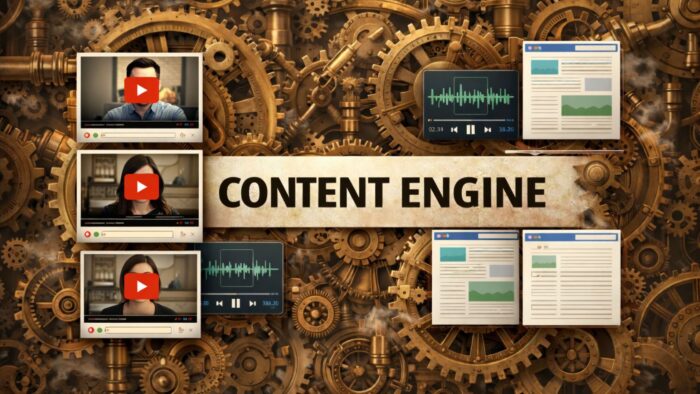
The content engine is the overarching, encompassing machine that drives strategy, tactics, formats, and channels of content. It connects every piece of content to a business purpose.
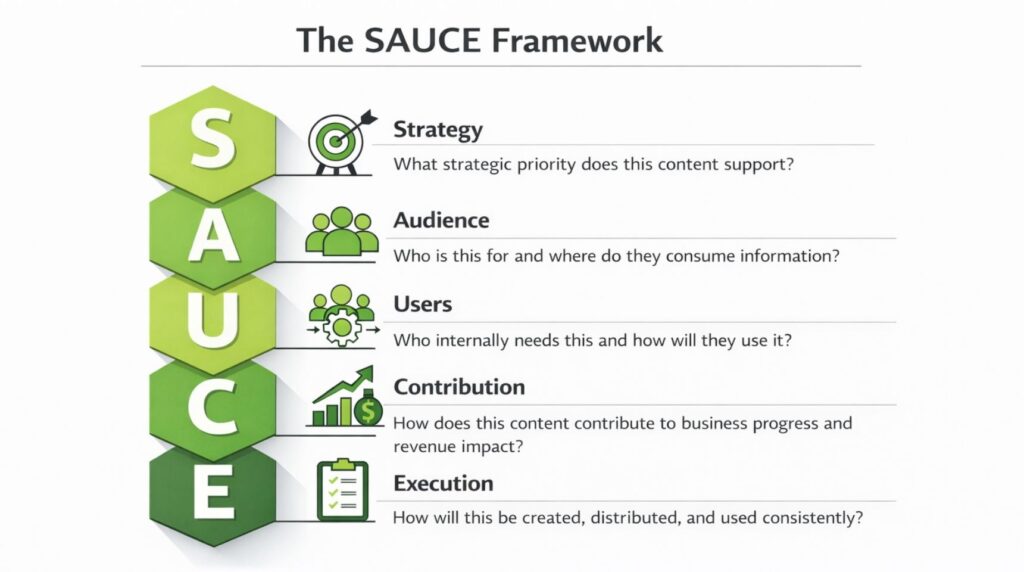
To build this machine, Content Monsta uses the SAUCE Framework:
- Strategy – What strategic priority does the content support?
- Audience – Who is the content for, and where do they consume it?
- Users – Who internally will use the content, and how?
- Contribution – How does the content support business progress and revenue?
- Execution – How is the content created, distributed, and reused?
This framework helps move content marketing from guesswork to a predictable business function.
Why Video Content Should Power the Content Engine
The most effective content engines are video-first.
Capturing experts on video allows us to get access to the people with the deep knowledge of a business and of the industry. It also allows us to capture natural language and forward-thinking information that is unique to the individual’s experience and expertise.
Experience and expertise are the first two Es of EEAT, which is Google’s ranking for Experience, Expertise, Authority, and Trust. Capturing conversations and interviews on video allows us to start capturing the natural expressions, experience, and expertise from thought leaders.
Because it is on video, we have already captured the visuals, the text, and the audio that can be reformatted, repurposed, and reused across multiple channels.
By starting with video, you can repurpose it into:
- Blog articles
- Email content
- Short clips for social
- Website content
- Internal training
- Sales enablement tools
This video content goes far beyond just being used for social. It can be used for the website. It can be used as sales enablement. It can even be used for training.
Video is the only content format that can give birth to all other forms of content. It’s the most scalable input in a content engine.
Understanding the Content Hierarchy
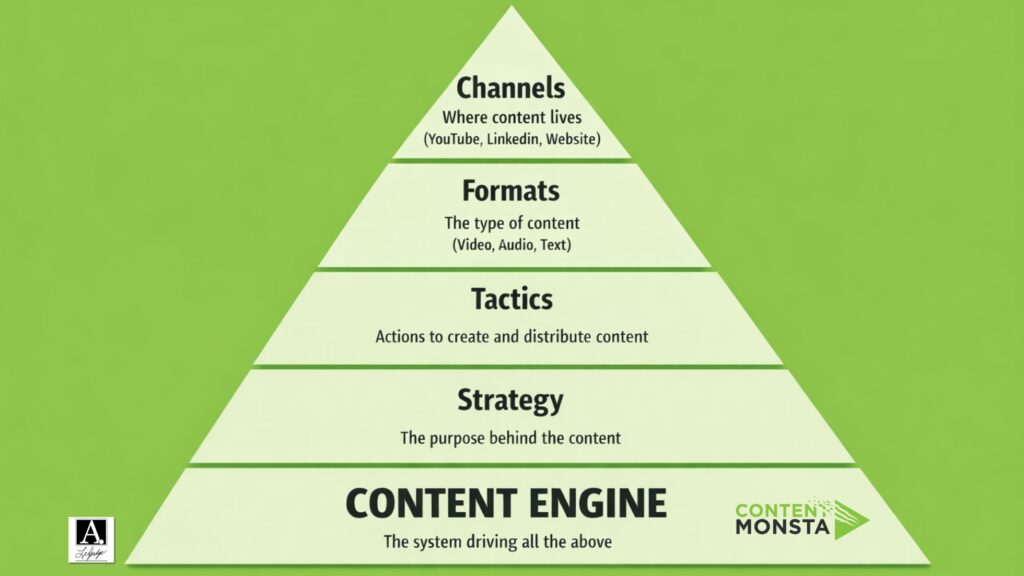
To build an effective content engine, you need to understand how content elements stack together.
- Channels – where content lives (YouTube, LinkedIn, website)
- Formats – the type of content (video, audio, text)
- Tactics – the actions taken to create and distribute content
- Strategy – the purpose behind the content
- Content Engine – the system driving all the above
Most companies make the mistake of starting at the bottom. They begin with the channel and work their way up, which creates disconnected content that’s difficult to repurpose.
Start at the bottom – with the content engine and strategy as your strong base – and work your way up.
For Content Creation – Start with Format, Not Channel
Even at the content-creation level, it’s important to start with the format before the channel.
Often, companies say, “Let’s do a podcast.” That is a channel. The format is audio and/or video. The format can go across multiple channels, so if you start with the format first, such as video, that video can serve the purpose of multiple channels such as YouTube, your website, social training, and sales enablement.
When you think format-first, you create content that can be repurposed. When you think channel-first, you create content that’s locked into one place.
Content must support a business purpose , not vanity metrics.
What Not Having a Content Engine Means
Without a content engine in place, companies face:
- No clear business objective behind content
- Creating content for vanity metrics
- Lack of planning around formats and workflows
- Inconsistent team roles and unclear ownership
- Measuring success only at the post or channel level
The solution is to start at the top, with strategy, format, and internal alignment.
How the SAUCE Framework Aligns Sales and Marketing
The SAUCE Framework creates alignment across departments.
- Strategy supports the business , not just marketing goals.
- Audience is defined by marketing, sales, and customer service together.
- Users include both external customers and internal teams like sales or HR.
- Contribution focuses on how content impacts business progress and revenue , a key area of interest for Sales.
- Execution involves the right people , especially those with expertise like Sales and Leadership.
When these teams are part of content creation, they are more likely to distribute it and support it.
The SAUCE Framework allows companies to justify content marketing as a business function, align teams on why content is created and how it’s used, and connect content to revenue impact and strategic priorities.
When Do You Need a Content Engine?
If any of these apply to your business, it’s time to build a Content Engine:
- Need for more brand visibility
- Leadership visibility is low
- Deals stalling while buyers research
- Competitors are reaching your prospects first
- Inefficient or unused content
- Stale or outdated content
- Sales is asking for better support
- Low internal visibility for marketing efforts
- Poor SEO, GEO, or AI search visibility
- Content variety is limited
- Social or YouTube presence is weak
How to Start Building Your Content Engine
Begin with the SAUCE Framework:
- Understand your business strategy and content’s role in it
- Plan for formats then channels, not just individual pieces
- Assign clear team roles
- Define KPIs for the overall engine, not individual posts or channels
The content engine is part of your marketing strategy, not just a series of posts.
What Changes When Your Content Engine Is Running
When it’s running properly:
- KPIs are measured at the system level , not per post
- Content serves business outcomes, not vanity metrics
- Teams are aligned and working together
- Leadership sees the value of content marketing
The content engine turns content into a business asset – not a creative task.
Why Build a Content Engine?
A content engine turns content from a creative task into a business asset. It gives your team a repeatable, scalable system to create, distribute, and reuse content that supports growth.
And when you start with video, you multiply every effort. You get the thought leadership, the SEO benefit, the social presence, and the internal tools your team needs — all from a single content source.
Build the engine first. Then the content moves your business forward.
Key Takeaways
- A content engine drives strategic and purposeful content creation, aligning with business objectives rather than vanity metrics.
- The SAUCE Framework helps configure this content engine by focusing on strategy, audience, users, contribution, and execution.
- Video content should be at the core of your content engine, allowing repurposing into formats like blogs, social media, and training materials.
- Without a content engine, companies risk unclear objectives, disconnected content, and inefficient marketing efforts.
- Building a content engine transforms content into a business asset, enhancing brand visibility and supporting overall growth.