

When I talk about content strategy, I keep coming back to one idea. Information gain.
It is important because it gets to the heart of what makes content useful. It asks a simple question. Does this content add something new, or does it just repeat what is already out there?
That question is important for search. It is important for AI. It is important for people.
The most valuable content usually does not come from rewriting public information better. It comes from pulling out the experience, judgment, and insight that already exists inside the business.
That is where information gain lives.
What Information Gain Actually Means
Information gain measures whether your content contributes new knowledge.
That new knowledge can take several forms. It might be:
- A fresh idea
- A useful perspective
- A new format
- First-hand experience
- A lesson learned from real work
- A process that has been tested
- Data from inside the business
- An expert opinion based on years of practice
- A clearer explanation that helps people understand something in a new way
Low information gain content usually says what many other pages already say. It may be well written. It may even be accurate. It does not move the conversation forward.
That is the difference.
A page with low information gain summarizes. A page with high information gain teaches.
The Old Content Playbook Has Lost Its Edge
For a long time, many content teams could win by producing more articles, targeting more keywords, and organizing existing information in a cleaner format.
That approach is weaker now.
Since 2022 and the onset of ChatGPT, many companies began cranking out informational blog articles to fill their sites with information. That kind of information can be useful if the only goal is to educate the customer. The more important part of content is getting the customer to understand that your company is unique, and that your company has experiences and expertise that earn their trust more than the next company. Volume alone does not do that.
Search engines have become better at recognizing when content lacks originality. AI systems have made this even more obvious. Large language models can generate decent summaries of public information in seconds. If your content is based on the same material everyone else is using, there is very little reason for a human reader to choose it, and very little reason for an AI system to treat it as a strong source.
That is why original thinking is more important. LLMs weigh original thinking more heavily when forming their understanding of a category, and human readers engage more with content that gives them something they cannot get anywhere else.
Every piece of content should contribute something of value that is rooted in real knowledge.
The Problem With Restated Content
A lot of content looks useful on the surface and adds very little.
You have probably seen this kind of article before. Ten websites publish a post on the same topic. They use similar headlines. They follow the same structure. They define the term. They list a few best practices. They end with the same general advice.
Nothing in those articles is wrong. The problem is that none of them say much worth remembering.
This creates three problems.
First, it makes your brand sound like everyone else.
Second, it gives your audience no clear reason to trust you over another source.
Third, it limits your visibility in a world where both search engines and AI systems are getting better at detecting repeated ideas.
When content is built by collecting what has already been published, the result is usually safe, polished, and forgettable.
What I Have Seen Happen When Content Actually Earns Trust
On more than one occasion, I have had clients tell me how elated they were when a prospect mentioned that they had been consuming their content for months before ever reaching out.
In one case, the prospect had been listening to the client’s podcast. In another case, the prospect had been watching the client’s YouTube videos. I have seen the same thing happen inside my own company. A client we thought had gone cold months earlier came back and told us that we had earned their trust through the content we kept sharing.
That is the quiet power of high information gain content. It is working for you before you ever know the buyer exists.
When content is generic, that does not happen. Generic content gets consumed and forgotten. The brand behind it does not stick.
A Real Example of Reshaping Generic Content
One of our clients came to us with a large volume of blog articles. They had been publishing for years. When we examined the library, we found that the articles were generic. They did not have any unique or new information.
The articles read like something any company in the industry could have published.
Here is what we did. We interviewed their subject matter experts on those same topics. We pulled out proof, opinion, experience, and trust signals that were unique to that company. Then we enhanced the articles to make them more valuable and more likely to appear in both traditional search and AI search.
The topic did not change. The value of the content did. The difference came from the human experience we pulled into each article.
What High Information Gain Content Looks Like
High information gain content often feels more specific, more grounded, and more useful.
It may include:
1. Real Experience
An internal expert explains what actually happened in the field, in the sales process, in the customer conversation, or during implementation.
For example, instead of saying, “sales and marketing alignment is important,” an expert might say, “We found that our sales team stopped using case studies because the stories were too broad. Once we rebuilt them around specific objections, usage went up.”
That second version adds knowledge. It comes from lived experience.
2. Original Points of View
A unique perspective can create information gain even without proprietary data.
Many people define thought leadership as publishing opinions. I would argue that real thought leadership comes from making expert knowledge useful to the buyer. That shift in framing helps people think differently about the purpose of content.
That is information gain because it changes understanding.
3. Internal Patterns and Observations
Companies often sit on valuable insight without realizing it.
Customer success teams hear the same questions over and over. Sales teams hear the same objections. Product teams see the same adoption problems. Executives notice changes in buyer behavior. Subject matter experts know where common advice falls apart in real life.
Those patterns are a source of original content.
4. Clearer Explanations That Improve Understanding
Sometimes the new value is not a new fact. It is a better explanation.
An expert can take a topic that has been explained in vague language and make it practical. That is still information gain because the audience leaves with more understanding than they had before.
5. Specific Application
Generic content says what something is. High information gain content shows how it works in context.
A broad article about video marketing is easy to find. An article that explains how a B2B sales team can use expert-led video clips to answer objections late in the buying process is far more useful to a specific audience.
Information Gain Is Not the Same as Thought Leadership
There is a difference between information gain and what most marketers call thought leadership.
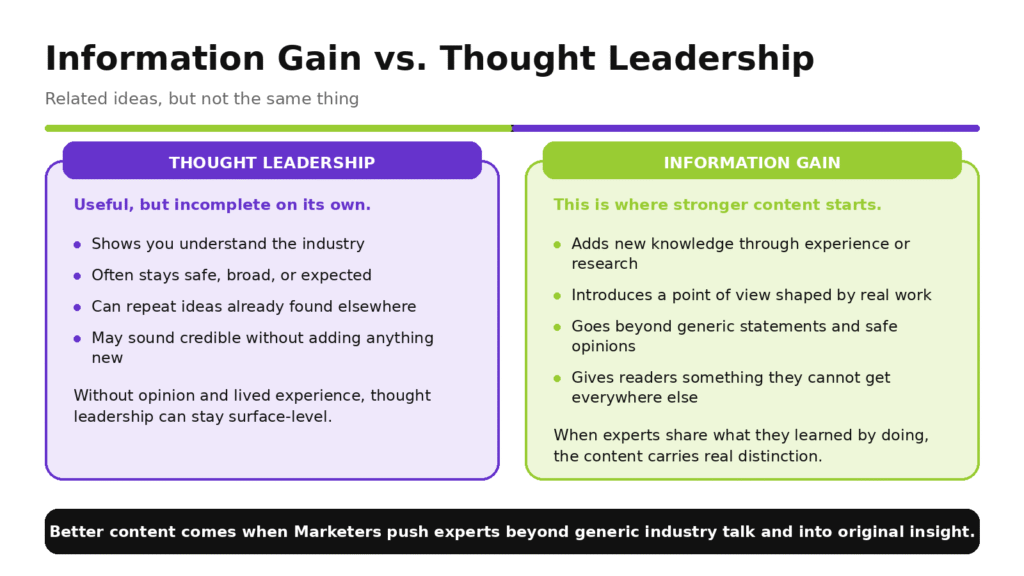
If thought leadership is simply stating knowledge of the industry, it lacks the opinions of the person speaking. It lacks their experience. Their experience is unique to them. They have gained information through that experience. So when a person contributes to a business’s content through their own experience or their own research, they have new information to share.
That is information gain. Not just thought leadership.
Marketers need to push their subject matter experts and leaders to go beyond safe, go beyond generic, and go beyond saying the same things everyone else in the industry says. That is how you get to information gain and better content.
Information Gain Is Not the Same as Novelty
This is another important distinction.
Information gain does not require you to invent a brand-new topic. Most businesses do not need to create new theories every week.
What they need is to add depth, context, and practical insight to topics their audience already cares about.
“How to improve onboarding” is not a new topic. A company that has onboarded hundreds of enterprise clients may have very useful things to say about where onboarding breaks down, what clients misunderstand early, and which actions lead to faster adoption.
The topic is common. The insight is not.
That is the opportunity.
Why Internal Experts Are the Best Source of Information Gain
Most organizations already have the raw material for strong content. It is sitting in the minds of the people doing the work.
The challenge is that expert knowledge often stays trapped.
Experts are busy. They may not think like marketers. They may assume what they know is obvious. They may explain things verbally much better than they write them.
So the content team ends up doing what feels easier. They research existing articles, collect secondary sources, and build content from what is already public.
That process produces content. It does not always produce useful content.
When we work from internal expertise, we get access to things that competitors cannot easily copy:
- Practical knowledge
- Customer understanding
- Internal stories
- Tested methods
- Informed opinions
- Lived experience
That is the kind of material that creates information gain.
How We Pull Information Gain Out of Subject Matter Experts
When we sit down to interview a client, we use the POET framework. POET stands for Proof, Opinion, Experience, and Trust.
Out of those four, the opinion and experience questions tend to produce the most valuable content. That is where experts begin telling stories and sharing experiences inside their company that no other company could demonstrate. Those stories and demonstrations of experience lead to trust for the people who consume the content.
POET gives us a repeatable way to move past generic answers and pull out what only that expert can say.

How VOICE Inside RevCO Supports Information Gain
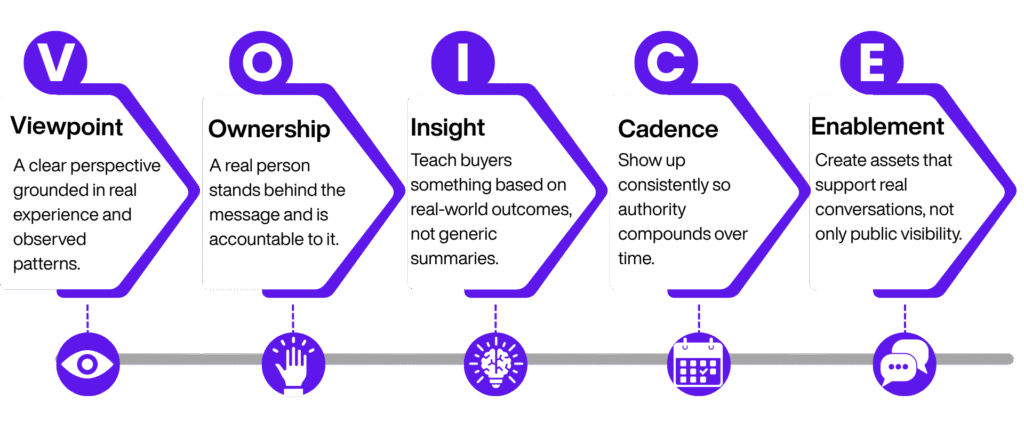
Information gain does not show up by accident. It requires a structure that puts a credible human behind the content. That is exactly what the VOICE framework inside my RevCO model is built for.
VOICE stands for Viewpoint, Ownership, Insight, Cadence, and Enablement. The elements are designed to make sure there is a human behind the content, a trustworthy human who makes a human connection and stands behind the message in a way that a general marketer or content writer could not do alone.
When a marketer skips VOICE, they miss the chance to decide who should carry the message. And without a carrier, content goes back to being generic.
Information gain and VOICE work together. VOICE identifies the expert. POET extracts what the expert knows. The combination produces content the audience cannot get anywhere else.
A Simple Way to Test for Information Gain
When I evaluate content, I like to ask a few direct questions.
Would This Still Be Useful if Search Engines Did Not Exist?
If the answer is no, the content may be too focused on ranking and not focused enough on helping.
Could a General AI Tool Produce Something Very Similar From Public Sources?
If yes, the content probably needs stronger original input.
Does This Include Anything That Came From Real Conversations, Real Work, or Real Expertise?
If not, there may be no true value added.
Does the Audience Learn Something Specific That They Can Use?
If the takeaway is too broad, the information gain is likely weak.
Is There a Clear Point of View?
Content without a point of view often sounds generic. A grounded perspective helps create distinction.
What Low Information Gain Sounds Like
Low information gain content usually has a few signs:
- Broad definitions with no depth
- Lists of tips that could apply to anyone
- Advice with no examples
- Ideas gathered from other blogs with no expert input
- Polished language that says very little
- Conclusions that stay safe and general
A good test is this. After reading it, can the audience repeat one thing they learned that they did not already know?
If they cannot, the content may be clean, and it is not memorable.
What High Information Gain Sounds Like
High information gain content tends to sound more confident and more useful because it is built on something real.
It often includes phrases like:
- “What we have seen is…”
- “One mistake teams make is…”
- “In our experience…”
- “Clients often assume…, and what works better is…”
- “Here is where this breaks down in practice…”
- “The pattern we noticed was…”
These statements are stronger because they come from observation, not recycled explanation.
How to Create Content With More Information Gain
This is where process is important.
You do not get better content by telling writers to “be more original.” You get better content by building a better source of input.
Here is the approach I believe in.
Start With the Expert, Not the Keyword
Keywords help us understand demand. They do not provide depth.
I want to know what the audience is searching for, and I also want to know what the internal expert understands that the audience has not heard explained clearly.
That is where the stronger content begins.
Pull for Experience, Not Polished Statements
Experts often give generic answers at first because that is how they think they are supposed to sound.
The real value comes when you ask better follow-up questions.
What happened? What surprised you? What do customers misunderstand? Where does the common advice fail? What do you do differently? What have you changed your mind about?
Those questions uncover information gain.
Capture Examples
Examples make insight concrete.
If an expert says, “personalized outreach works better,” I want the next layer. Better for whom? In what situation? What changed? What made it effective?
The example is often where the real lesson shows up.
Look for Tension
Strong insight often appears where there is a gap between common advice and real-world practice.
A company may say, “Everyone tells marketers to write for keywords first. We found that starting with what our engineers had already solved for customers produced better sales conversations.”
That tension creates interest because it challenges assumptions.
Build Around What Only Your Client Can Say
This is one of the most useful filters.
Ask, what can this company say that another company cannot honestly copy?
That may be their process. Their lessons. Their mistakes. Their customer patterns. Their expertise. Their stories.
That is the material worth building around.
How Format Itself Can Add Information Gain
Information gain is not limited to new ideas. It can also come from new formats.
The same knowledge can carry very different weight depending on how it is delivered. A written explanation is one thing. A short video of the expert explaining it in their own words is another. A dense paragraph is one thing. A clear chart or diagram that shows the same information at a glance is another.
The underlying knowledge may already exist on the internet. Format can add clarity, context, and trust that the text alone could not deliver.
Here are a few examples of how format creates information gain.
Adding a Face to the Information
A written article about a topic is useful. The same article paired with a short video clip of the internal expert explaining the point is more valuable.
The face on camera adds trust signals that text cannot carry. The audience sees who is speaking, hears how they explain the idea, and picks up on tone and confidence. That is information a reader cannot get from a block of text.
For B2B buyers especially, seeing the person behind the message changes how the content lands.
Replacing Dense Text With a Visual
Some ideas are hard to read and easy to see.
A paragraph full of steps, relationships, or comparisons often becomes clearer as a diagram, a flow, or a simple chart. The reader understands the idea faster and remembers it longer.
That is information gain because the audience leaves with more understanding than they had before. The gain is in clarity.
Turning a Long Explanation Into a Short Demonstration
A written walkthrough of how something works can be improved by showing it in action. A quick screen recording, a short demo, or a before-and-after visual can replace three paragraphs of description.
The audience gets the point faster, and the proof comes from seeing the thing happen rather than reading about it.
Giving the Same Idea More Than One Entry Point
Different people consume content differently. Some read. Some watch. Some listen. Some look for a quick visual summary.
Offering the same core insight across formats is itself a form of information gain. It widens the audience that can access the knowledge and deepens the experience for the audience who chooses more than one format.
That is why video, podcast, and visual content work so well alongside written articles. Each format carries information the others cannot.
Be Mindful of Where the Content Advice You Follow Comes From
Many SEO companies and AI search visibility vendors have motives to sell you software for measurement. It is important to understand where your information about what kind of content to create is actually coming from.
At the end of the day, you are creating content for humans. Those humans do not always click when they consume your content, and they do make a judgment.
The approach I believe in is focused on creating content from humans, for humans, in a way that builds credibility for a business. It does not work to build SEO or AI search vanity metrics. It seeks to engage humans in a way that builds trust. The result is humans responding with trust signals that feed back into a higher probability of showing up in AI search results and better SEO.
The goal is to create content that moves business forward. The goal is not vanity metrics. The goal is not to win SEO awards or AI search awards. The goal is to move prospective customers toward doing business with us.
The Link Between Information Gain and Trust
People trust content that feels earned.
A reader can usually tell when an article is built from surface research and when it is built from real understanding. One sounds assembled. The other sounds informed.
Trust grows when content reflects:
- Practical experience
- Honest nuance
- Clear thinking
- Specifics
- Evidence from real work
This is important in B2B marketing because buyers are not just looking for definitions. They are looking for guidance. They want to know who understands the problem well enough to help solve it.
Information gain supports that trust because it proves the content comes from substance.
The Link Between Information Gain and Brand Value
There is also a branding issue here.
Every piece of generic content weakens differentiation. It trains the audience to see your company as one more voice saying the same thing.
Every piece of high information gain content can do the opposite. It can show how your company thinks, what your experts have learned, and why your perspective deserves attention.
That is bigger than SEO. It shapes how the market sees you.
Why Information Gain Shapes the Future of Content
The more content the internet produces, the more valuable real expertise becomes.
That is the shift many brands are still catching up to.
The old advantage was volume. The stronger advantage is insight.
Anyone can produce content at scale. Fewer teams can produce content with depth. Even fewer can do it consistently from the real knowledge inside their organization.
That is why I see information gain as one of the most useful standards for content quality. It pushes us to stop asking, “Can we publish something on this topic?” and start asking, “What can we add that is worth someone’s time?”
That is a better question for marketers. It is a better question for brands. It is a better question for the audience.
Here’s the Wrap
Information gain is the measure of whether content adds new knowledge or repeats what is already available elsewhere.
That is a simple idea, and it has major consequences.
It affects how useful your content is. It affects how memorable your brand is. It affects how search engines and AI systems interpret your authority. It affects whether your audience leaves with something they can actually use.
The best path to information gain is clear. Stop relying so heavily on public summaries. Start extracting more from the people inside the business who already know the work, the customers, and the reality behind the topic.
That is how content becomes original. That is how it becomes helpful. That is how it becomes worth publishing.
If you want to keep pushing your content strategy toward ROI and business impact, learn about the other RevCo components: Sauce, Voice, and Trace. And keep building assets that are relevant, easy, answer questions, de-risk decisions, and yield momentum.
=======
About A. Lee Judge
A. Lee Judge is a Keynote Speaker on Sales and Marketing and the author of CASH: The 4 Keys to Better Sales, Smarter Marketing, and a Supercharged Revenue Machine. With 20 years of enterprise experience, A. Lee Judge is sought after by Sales and Marketing leaders and is the founder of Content Monsta, a B2B video and podcast production company. Revenue Teams book A. Lee Judge for company kickoff events, SKOs, RKOs, and executive meetings. He delivers practical frameworks that align Sales and Marketing, connect content to revenue, and drive measurable results. As a Sales and Marketing Speaker and advisor, A. Lee Judge equips teams with actions they can use right away.