
How do we get our brand to show up when a buyer asks ChatGPT, Claude, or Google Overviews about what we do?
It is a fair question. Many of the answers floating around are guesses dressed up as tactics.
The real answer comes down to three practices:
- Answer one buyer question per video.
- Say the answer out loud in full sentences so the transcript carries it.
- Surround the video with supporting text: the title, description, chapters, and a companion article.
None of these involve tricks. Before we get into how to apply each one, here is the data that shows why video deserves this attention.
Why YouTube Is One of the Strongest AI Search Assets You Own
Meltwater analyzed more than 8 million AI citations across eight language models. YouTube was the most-cited single source, ahead of Reddit and any individual news website.
Marketing Dive reported on research from LQ Digital showing that YouTube videos were 4.3 times more likely to appear in Google AI Overviews than in traditional search results.
So the videos you already make may be the strongest AI search asset your company has, if they are built the right way.
This matters most for B2B and other considered purchases, where the buyer asks many questions before they ever talk to Sales. The same three practices work for any company whose customers research before they buy.
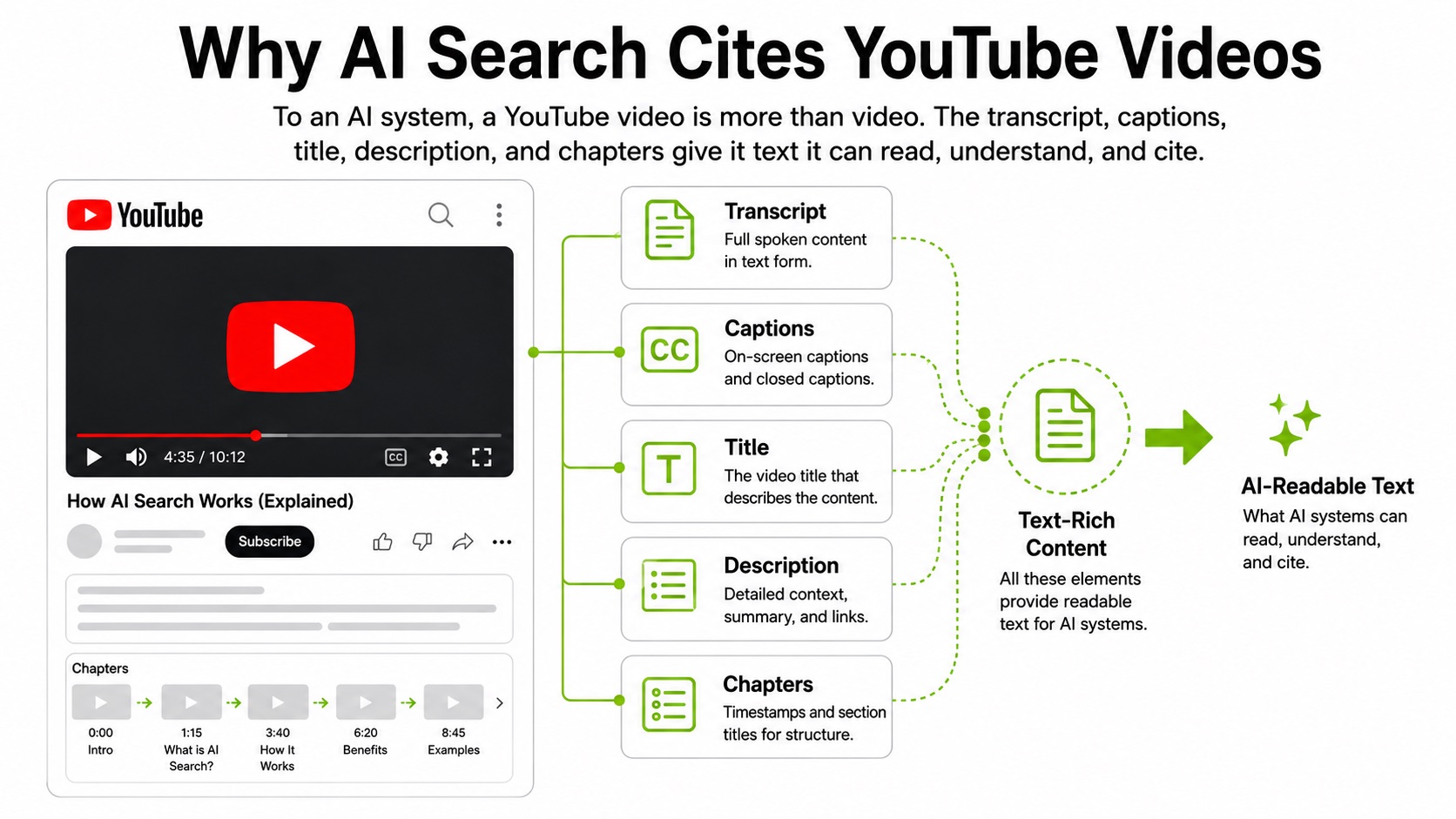
Why AI Search Cites YouTube Videos
To an AI system, a YouTube video is more than video. The transcript, captions, title, description, and chapters give it text it can read, understand, and cite.
When an AI system answers a question, it is looking for three things:
- A source that clearly answers the question
- A person who seems to know the subject
- A format it can read and quote
A YouTube video provides all three. The transcript is the text. The speaker on camera is the human expertise. The title, description, and chapters tell the system exactly what question the video answers.
This is less like a popularity contest and more like reference selection. The AI is picking the source that best matches the question.
The research supports that view. The OtterlyAI study of more than 100 million AI citations found that 94 percent of YouTube citations went to long-form videos. Only about 6 percent went to Shorts.
That same research found that roughly 41 percent of cited videos had fewer than a thousand views. The AI did not care how popular the video was. It cared whether the video answered the question.
Long videos that fully answer a question, from a credible person, with clear text around them. That is the pattern. The first practice is built directly on it.
Practice 1: Answer One Buyer Question Per Video
One video, one question. Not five tips. Not an overview of your category. One specific question that a buyer would type into a search box or ask an AI assistant.
The reason is simple. An AI system is matching a question to a source. A video that answers one question cleanly is an easy match. A video that touches on eight topics is a weak match for all eight.
Where the questions come from
Your Sales team hears them every day. Your support inbox is full of them. The comments on your existing content are a list of them.
Write the question the way the buyer asks it, and make that the title.
For example, “How long does a CRM migration take?” beats “CRM Migration Best Practices” every time.
Answer it completely
Do not hold back the real answer to get someone to fill out a form. A video that gives a partial answer gets passed over for a video that gives a full one.
Think of it as building a library. Every video is one question answered. Over a year you have fifty questions answered, and each one is a separate chance to be cited.
Do you know the top ten questions your buyers ask before they purchase? If the answer is no, that is the first project to start.
Picking the right question is half the work. How you say the answer is the other half.
Practice 2: Say the Answer Clearly, Because the Transcript Is What Gets Read
The words you speak on camera are turned into text. That text is what the AI reads. If the answer is vague or buried, the transcript is vague and buried too.
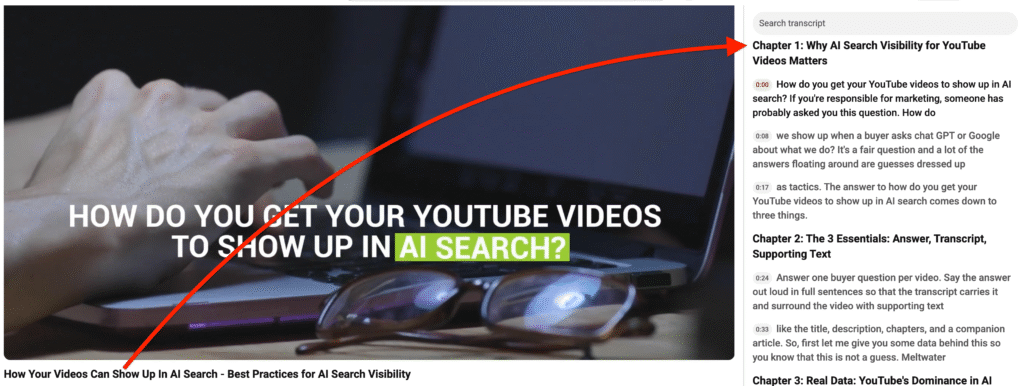
A few habits make a transcript work for you:
- State the question at the start, in plain words. “The question is, how long does a CRM migration take?”
- Give the direct answer early. “For a mid-sized company, plan on three to six months.” Then spend the rest of the video explaining why.
- Restate key points as complete sentences. Instead of “that’s the main reason,” say “the main reason migrations run long is data cleanup.” A complete sentence can be quoted. A fragment cannot.
- Use the actual words your buyers use. If they say “AI search” and you say “generative engine optimization,” you are speaking a different language than the question being asked.
- Avoid long stretches of banter. Banter is transcript that answers nothing.
- Upload a clean caption file, or at least review the auto-generated one. Product names and industry terms get transcribed wrong all the time. A wrong word in the transcript is a missed match.
Doing this well takes planning and a repeatable production process. That is the work Content Monsta does for clients. We create video content for companies that sell on expertise, built around the questions their buyers ask, so the videos get found and used. If you want help building videos this way, talk to us about video production.
Your words inside the video are one signal. The text around the video is the other.
Practice 3: Surround the Video With Supporting Content
A video does not get cited in isolation. It gets cited as part of a web of text that all points at the same question.
On YouTube
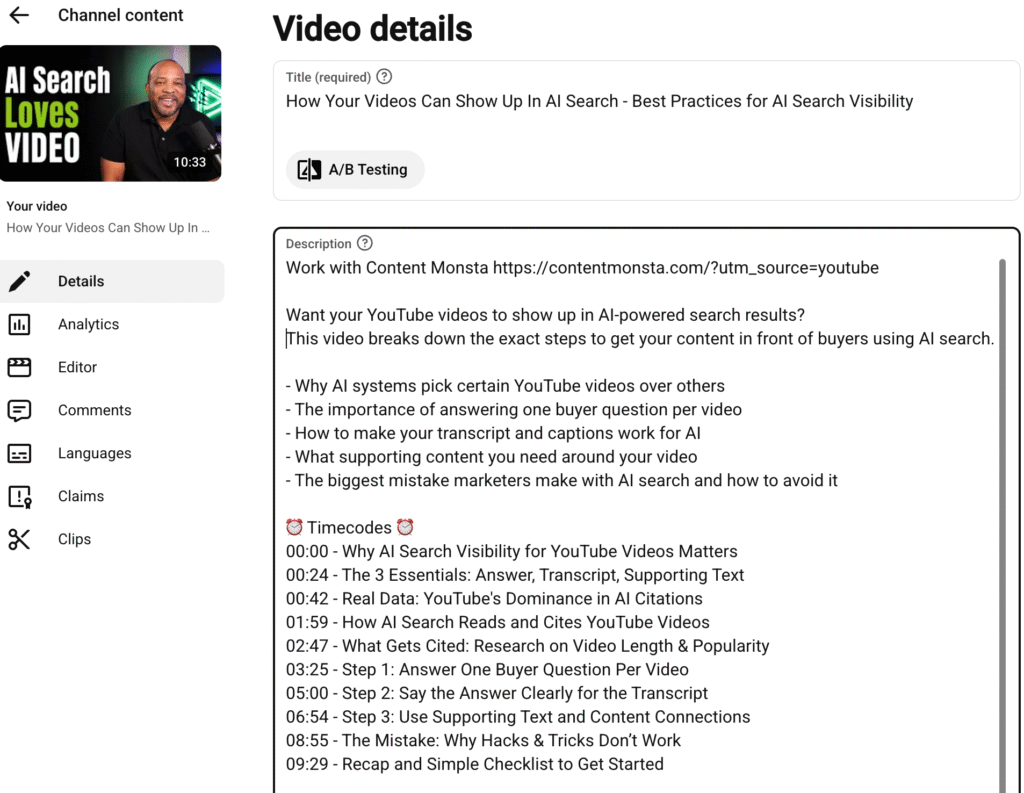
Title. Use the question, or the direct answer to the question, in natural language.
Description. The first two or three lines should restate the question and summarize the answer in plain sentences. This is text the AI reads before it ever gets to the transcript.
Chapters. Add chapters with timestamps, and name each chapter after the sub-question it answers. Research on AI citations has found that timestamped videos are more likely to be cited, because the system can point to the exact moment that answers the question.
Beyond YouTube
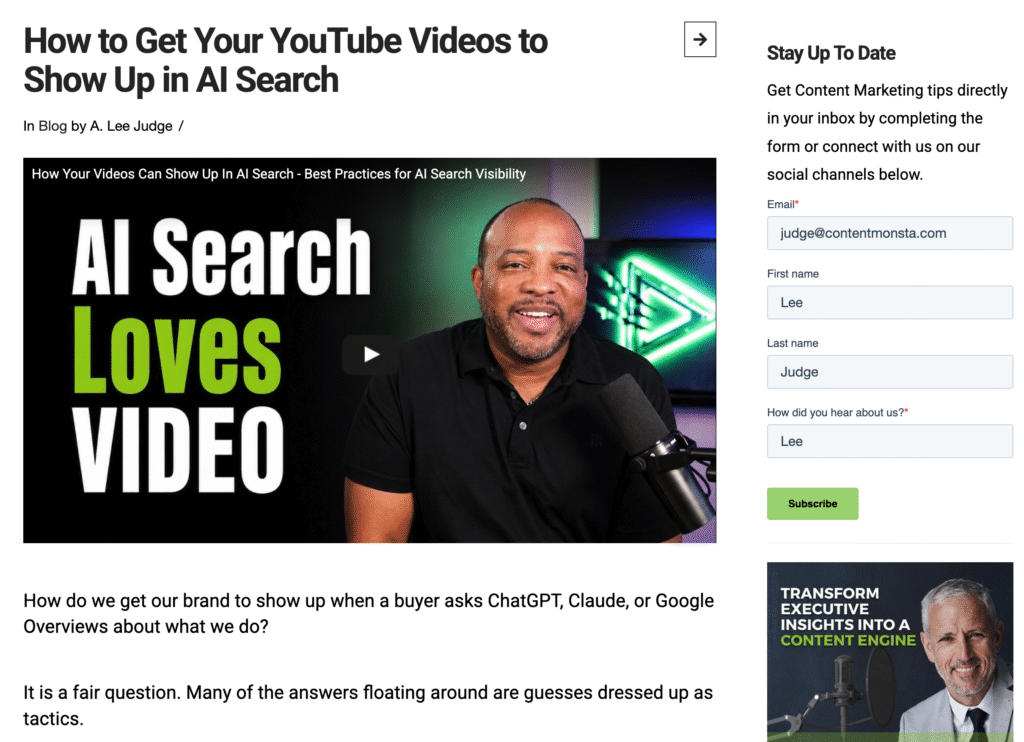
Publish a companion article. Write an article on your website that answers the same question. Embed the video in it, and link back to the video from the article. That gives you two sources with one answer, pointing at each other.
Connect related videos. If you have three videos on adjacent questions, link them in the descriptions and on the end screen. That tells the system you are a source on the whole topic, not a one-time answer.
Keep the expert consistent. When the same named person answers related questions across many videos and articles, that person becomes a recognizable authority. Authority is what AI systems are trying to identify.
The Mistake That Undoes All Three
The mistake is treating AI search like a trick you can run with a few settings.
People ask how to optimize for ChatGPT the way they once asked how to trick Google. Stuff the description with keywords. Post fifty Shorts. Use a tool that promises placement.
The research points the other way. Long-form videos win. Clear answers win. Named experts win. Low view counts still get cited when the answer is right.
The videos that AI search rewards are the same videos a real buyer would want to watch. There is no gap between good content and findable content here.
That is good news for any company with real expertise. The advantage goes to the company that captures what its people know and publishes it clearly. Nobody can generate that from nothing.
What to Do This Week
Pick one buyer question. Record a video that answers it completely. Say the answer out loud, in full sentences. Use the question as the title, add a description that summarizes the answer, add chapters, and link to an article.
Then repeat consistently.