
There is a path to creating quality content at scale
When AI landed on every desktop, marketers did what marketers do. We made content, and then we made more of it. Blog articles, podcasts, white papers, video scripts, all of it faster. Output went up across the board, but buyer behavior did not follow.
My Quality and Quantity master class covers why that happens and how to fix it with a formula, a framework, and a workflow you can build inside your own team.
Here is the short version.
Content Volume Was Never the Real Problem
Around 7.5 million blog posts go live every day, about 20 million videos get uploaded to YouTube every day, and business content sits right in the middle of those numbers. However, about 65% of marketing content never gets used by sales. I put that last number in front of an executive friend at a large bank, and it was the first thing he pointed to. He said, “that’s so true, we don’t use most of the content marketing makes.”
Quantity gets blamed for all of this, but it deserves a defense. Low output means you are invisible in your market, and that looks like silence. High output with nothing behind it is noise.
Both are losing positions, but with AI in the mix you no longer have to pick one.
Why AI Content Sounds Correct but Still Gets Ignored
The failure here is a quiet one, because calendars fill up, output charts point the right direction, and the team feels good about the pace. Meanwhile, the buyers do not move.
All AI is doing is predicting the next word, which means the writing can be technically accurate and completely generic at the same time. There is no stance in it, and without a stance, a reader has no reason to pay attention. There is also no lived experience behind it. AI has never closed a deal, and it has never sat in that nervous meeting where the client decides whether or not to trust you.
Buyers reward something different from what an AI model produces on its own. They want clarity about which choice fits their situation. They want information gain and they want signals that tell them a company can be trusted. Half of buyers weigh trust equally with cost and quality, but trust is the one thing a language model cannot produce on your behalf.
The cost of sounding generic shows up in three places.
- Authority gets harder to build
- Everyone in your category starts sounding identical because they are pulling from the same models
- Your sales team stops using what marketing makes because they know a competitor could have published the same thing.
Four habits are worth breaking right away:
- Prompting your way to finished content. Iteration is good, but prompting over and over with no human input in the middle only gets you to “good enough.”
- Asking AI to be a thought leader. AI cannot think. It predicts, and predictions are not leadership.
- Publishing trend summaries with no point of view. If you believe the market is moving a certain direction, say why you believe it.
- Repurposing weak content into more weak content. Turning a thin article into a thin script and a thin post multiplies the problem.
The Formula to a Large Quantity of Quality Content
The shift I am asking for is moving from producing more to producing differently, and the formula behind it is short.
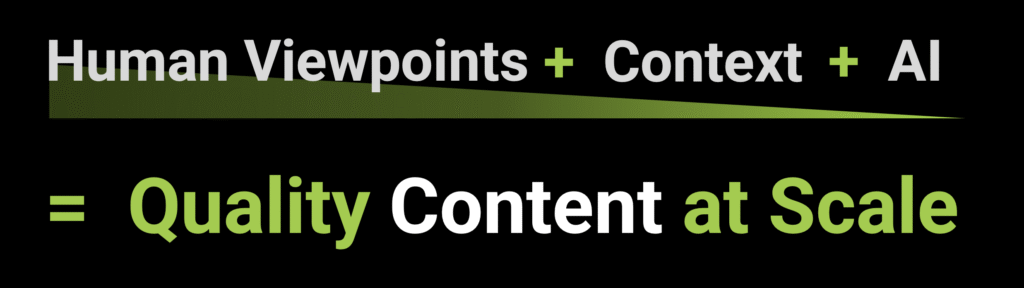
Human viewpoints carry most of the weight, context guides the work, and AI handles production. The real change happens on the input side, because most teams try to fix their output by asking AI for better content instead of handing AI better material.
A human viewpoint is judgment built from real experience. What do you believe, what have you watched fail, and what would you do instead? Those answers can come from one person or from the company as a whole, pulled out of the deals that closed, the ones that fell apart, and the products that did or did not perform.
POET: Getting the Viewpoint Out of Your Experts
Knowing you need human viewpoints and knowing how to get them are two different problems. Your engineers, executives, and subject matter experts hold the material, but they rarely hand it over on their own, and a vague request for “your thoughts on the topic” gets you a vague answer.
POET is the framework we built to solve that, and it stands for proof, opinion, experience, and trust. Take any article on your site written in 2022 or 2023 with heavy AI help, and I can almost guarantee it is missing all four.
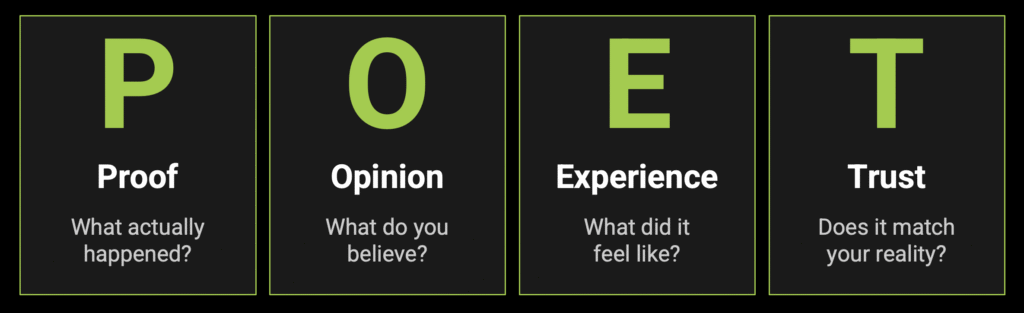
The move that makes this work is putting AI at the front of the process instead of the end. You give it the article or topic, who the reader is, what that reader is trying to solve, and what kind of proof your expert has available. AI writes the interview questions, and you go ask them.
Those questions should be uncomfortable to answer. We had a CEO tell us his questions were hard, and that was the point. Writing an AI article is easy, but getting real experience and opinion out of a person takes work from both of you. What comes back is material only your team could produce.
We packaged this as a free question builder at contentmonsta.com/poet. It is a large structured prompt with an interface on top, so you can build your own version. The important part is the role it plays: POET is not the content generator, it is the context engine that tells AI what to ask.
In the master class, I show a client clip that came out of this process, and I break down the exact words in that answer that AI could never have written.
Your Brand Guide Has a New Job – AI Context
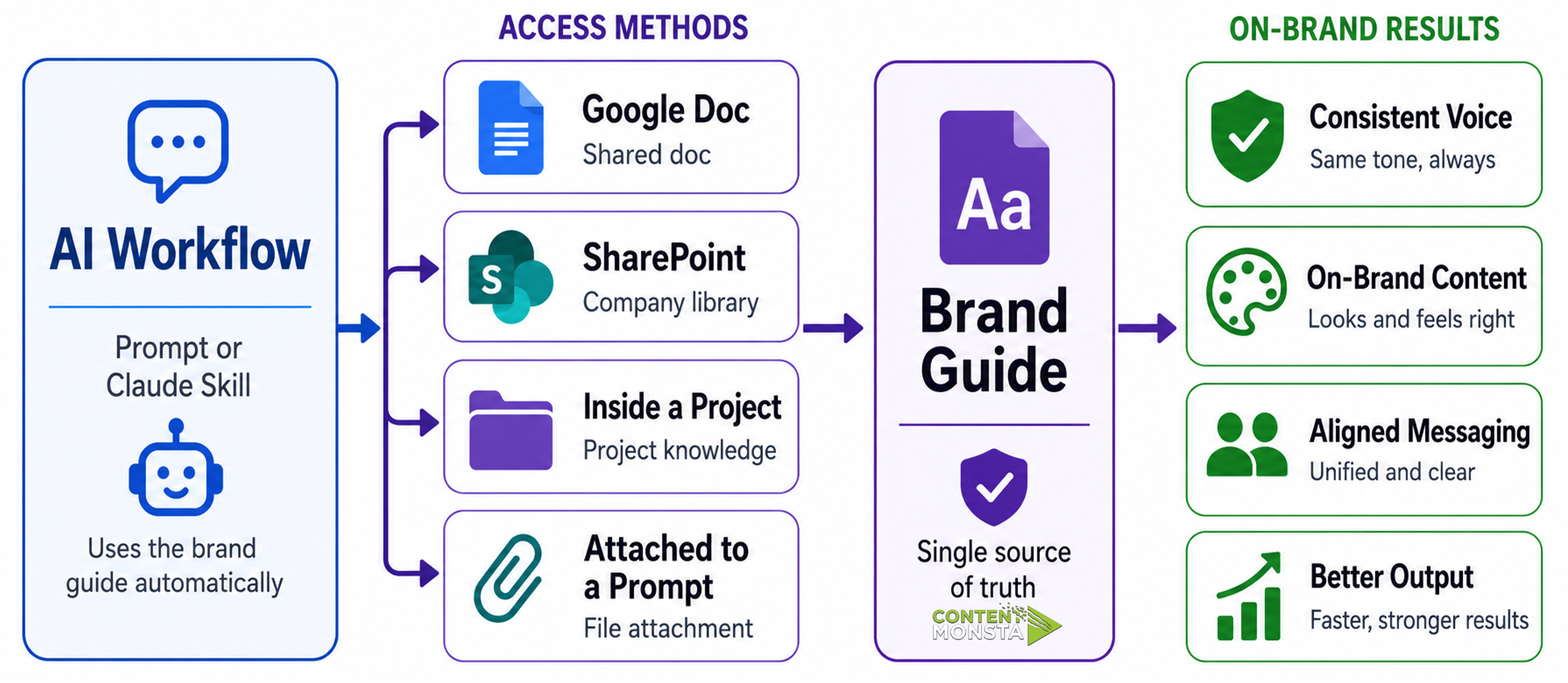
Most brand guides live in a folder and come out for new hires and new designers. In an AI workflow, that document becomes one of the most useful pieces of context you own. It holds your beliefs, the stances you take, your phrases, your values, your voice rules, and the boundaries around what your business does not do.
I keep a personal brand version on my phone and add to it whenever a phrase comes out that is purely mine. One of them is “you can’t get blood from a turnip,” which means you cannot get money out of a business that does not have any. I have watched that line show up in AI-assisted articles because the guide taught the model how I talk.
The part that makes this operational is access. That guide has to be reachable every single time content gets created, whether it sits in Google Docs, SharePoint, a ChatGPT project, a Claude project, or the prompt itself.
AI Is Your Productivity Engine
With viewpoints captured and context in place, AI does the work it is genuinely good at. It frames raw material like sales calls and transcripts into an angle, organizes large piles of loose information and surfaces what you almost missed, and gives all of it a through line that gets checked against your guidelines. Then it repurposes one strong asset into every format each channel needs.
Every platform needs its own version of the content, built for how people read and watch there. A blog article has a structure that a YouTube script does not share, and a LinkedIn post is different again. Build the workflow once per channel and the extra work of covering more platforms mostly disappears. My own setup tracks which formats an idea has been turned into and tells me what is missing. Teach that workflow to check its own output against POET, the brand guide, and the format rules before anything publishes.
Being on one channel is no longer enough, because AI search pulls from different places at different moments and no one can predict which. That stops being a resourcing problem once you can produce quality at volume.
Pick One Thing This Week
You can start by capturing your viewpoint in a document, or by interviewing one expert using POET and feeding that transcript back into your pipeline. You can also update one existing workflow so every piece has to pass the POET test before it goes out. Pick one and do it.
When everyone has the same AI, the only difference left is the human behind it.
Watch the Full Master Class Video
The full session includes the POET question examples, the client interview clip, the full workflow, and the repurposing checklist I run my content through. Watch it here.
Reach me on LinkedIn or at aleejudge.com with questions about applying this inside your team. My book, CASH: The 4 Keys to Better Sales, Smarter Marketing, and a Supercharged Revenue Machine, is available at aleejudge.com/cash.
About the Author
A. Lee Judge is the cofounder of Content Monsta, a podcast and video production agency that helps businesses create content to drive sales and marketing results. He is also the author of CASH: The 4 Keys to Better Sales, Smarter Marketing, and a Supercharged Revenue Machine.
- One Expert Interview Scaled Into Quality Content
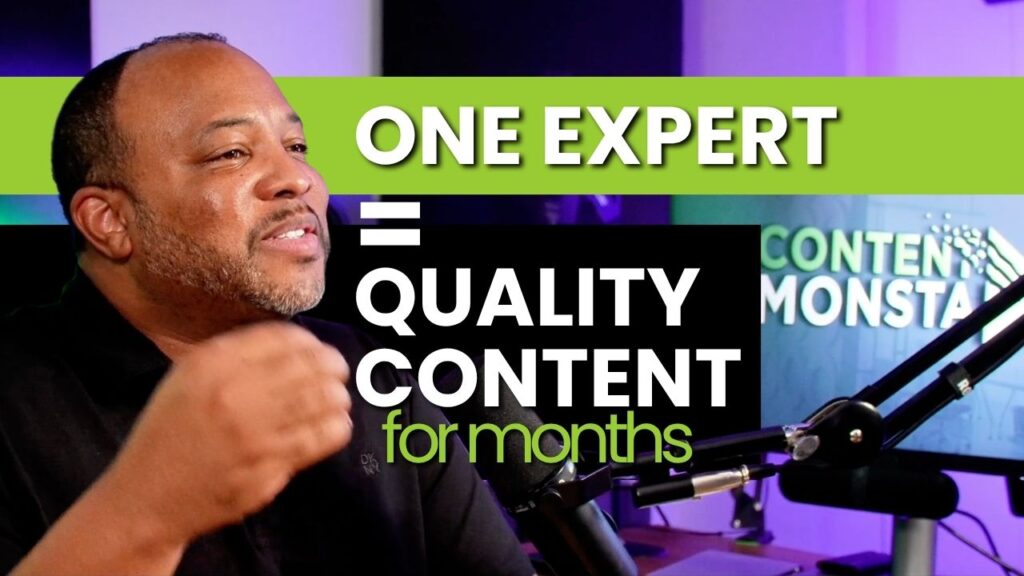 How to capture the expert’s knowledge once as a source and then build the assets from that source. Expertise sells and scales.
 - How to Get Your YouTube Videos to Show Up in AI Search
 YouTube videos are among the most-cited sources in AI search. You don’t even need a big audience to get cited. But you do need to get these few things right.
 - Quality and Quantity Content: How to Use AI to Achieve BothThere is a path to creating quality content at scale When …