
As a director of marketing inside a software company, I watched our team produce a steady stream of content that our sales team never touched. So I started asking why.
The answer had two parts. What marketing created did not match the pains sales was dealing with, and nobody in sales had been involved in creating it. I began recording conversations with our sales reps and executives and building content from those recordings, and the ignoring stopped.
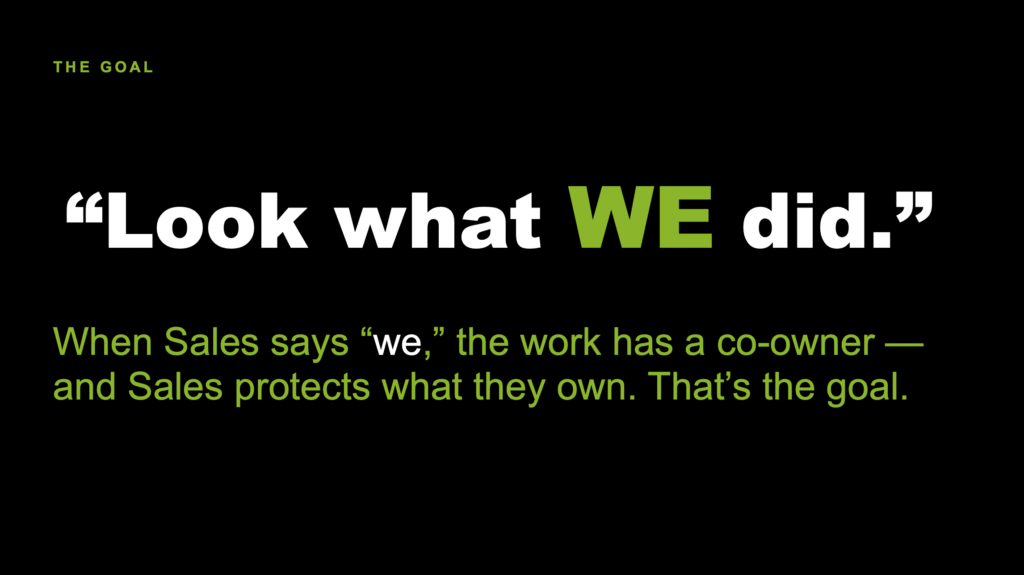
The goal I chased then is the same one I would hand you: get your sales team to look at a piece of content and say “look what we did.” You are one revenue team. When sales moves from “us versus them” to “we,” they celebrate the content wins with you.
The Make It Pretty Department
Plenty of marketing teams get treated as the make it pretty department. Build the PowerPoint. Design the trade show booth.
When that is the relationship, the cost of marketing shows up faster than the value. Budgets get cut there first, because a booth and a slide deck stop looking essential the moment finance goes looking for savings.
Meanwhile, reps rebuild their own content because they want something that speaks to the deal in front of them. Deals stall for reasons nobody traces back to marketing. Often the reason is that the content never met the customer at a key decision point in the deal.
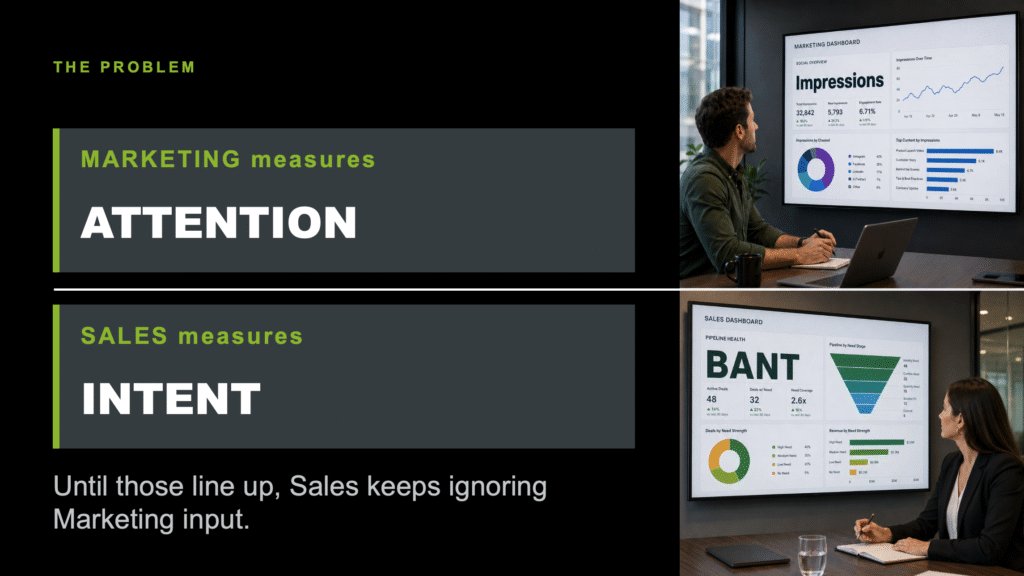
Marketing Measures Attention. Sales Measures Intent.
We measure attention with visits, form fills, downloads, and views. Sales runs on methodologies like BANT or MEDDIC, and what they are hunting for is intent. When marketing content does nothing to contribute to intent, a disconnect is guaranteed.
Marketing is in the deal conversation from day one, long before anyone in sales knows the buyer’s name. The handoff model is dead. Gartner has reported that B2B buyers spend roughly 17 percent of their buying process with all potential vendors combined, and only about 5 percent of that time with any single sales rep.
Look at the other side of that math. Around 70 percent of the buying process is finished before a buyer ever contacts sales to book a meeting. The old scoreboard cannot account for any of it.
Trade the Old Metrics for the Buyer’s Answers
Replace scoreboard metrics with answers you collect from buyers directly:
- How did you first start researching this topic, or us?
- What have you read or watched from us before reaching out?
- How long have you been looking into a solution?
When a customer says they have been consuming your content for months and a salesperson hears it, that rep has just heard proof that marketing contributed to the deal. Your job is to capture those comments and ask sales to listen for them.
I came up through marketing operations, where the goal was clean fields and clean dropdowns. Messy data was the enemy. AI changed that, because unstructured answers pulled from real conversations can be sorted, understood, and reported on, which means an open field asking how someone learned about you is worth more than a tidy dropdown that flattens the real answer.
The Content Gold Sits in Sales Conversations
Your reps already hold the raw material. They hear the objections, the friction, and which competitors keep coming up. They hear the questions customers ask before deciding and the exact words customers use to ask them.
That language matters. You may be marketing a Widget 3000 while the buyer keeps saying they just want a wrench. Sales knows which one the customer says out loud.
They also hold the stories. What happened before a customer chose you, and why the ones who said no said no.
Do Not Ask Sales to Write. Ask Sales to Talk.
Asking sales to produce content rarely works. Interrogating them works even worse, because it reads as marketing asking for help doing a marketing job.
Content quotas are the version I see most often, and they fail on arrival. When a VP of sales tells reps to submit a set number of pieces per month, reps resent the ask and hand in AI slop, and marketing ends up doing more work than before.
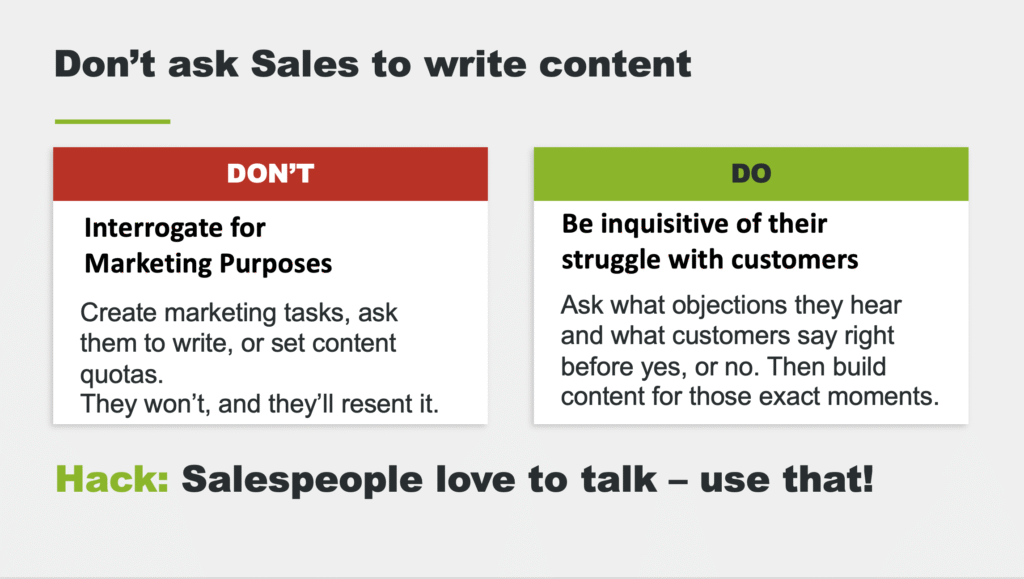
Be inquisitive about their job instead. Ask what objections they hear, set a regular meeting, and find out what customers say right before the yes or the no. Then build content for those exact moments.
Frame sales as the source of your content, and let marketing be the author. You do the building. Lead with respect for their authority on closing deals and position yourself as their deal-closing partner, because reps open up when they feel respected as the experts they are.
A Workflow for Pulling Content Out of Sales
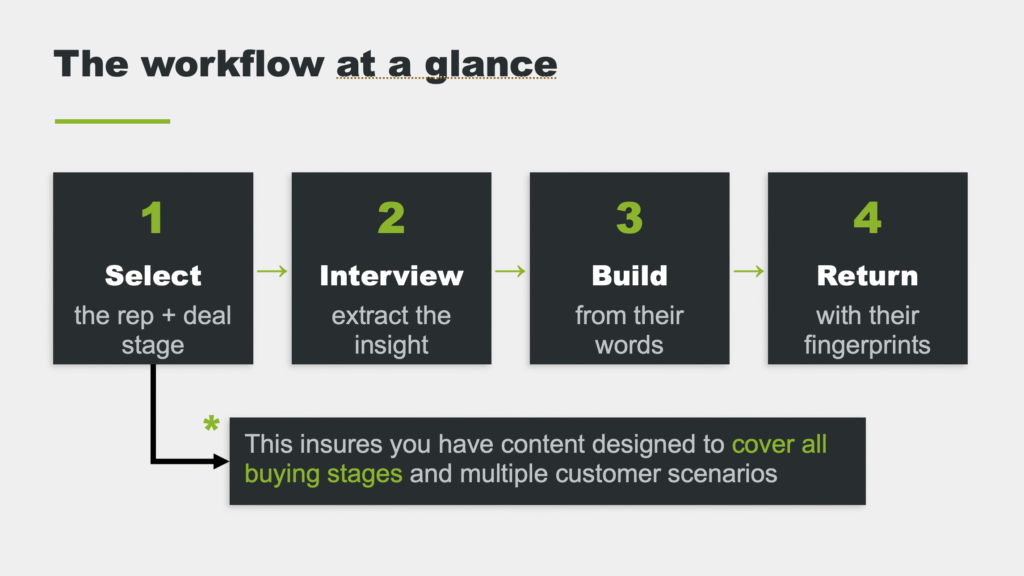
- Pick the rep and the deal stage. Do not try to solve the whole funnel in one interview. Early stage means objections, mid stage means proof and value points, and late stage means the trust factors that push a deal across the line.
- Run a recorded interview. Fifteen to twenty minutes respects their time. Use the same questions every time so your output stays comparable across conversations.
- Capture exact words, not summaries. The transcript is what you mine. You are not scripting a webinar; you want unfiltered stories in their language and the customer’s language.
- Build from their words. Their objections give you the structure and their stories become the proof.
- Return it with their credit. Put the rep’s name in the content.
Fingerprints are what make this work. A rep who sees a pain they actually had, an objection they hear weekly, or their own name inside a piece of content will defend that content and use it. A little FOMO builds across the team, because the next rep wants their voice in there too.
POET: Getting the Right Material Out of the Interview
The workflow only pays off if the interview pulls the right material, so we run these conversations through a framework called POET.
- Proof. What actual evidence exists that what you sell works?
- Opinion. What does your rep believe about how the product should be used, and what do they hear customers believe?
- Experience. Tell me about a real deal. What had to be explained, and then re-explained?
- Trust. What makes a buyer believe in this?
Answers to those four will never match your competitors’ content, and they will never match what AI produces on its own. They reflect real scenarios inside your organization.
READY: The Test for Sales-Ready Content
POET gets the insight out of sales. READY confirms the finished piece is something sales will actually use. It sits inside a larger model I built called RevCode, alongside frameworks for why a piece should exist, who inside your company should voice it, and how you trace its influence on revenue over time.
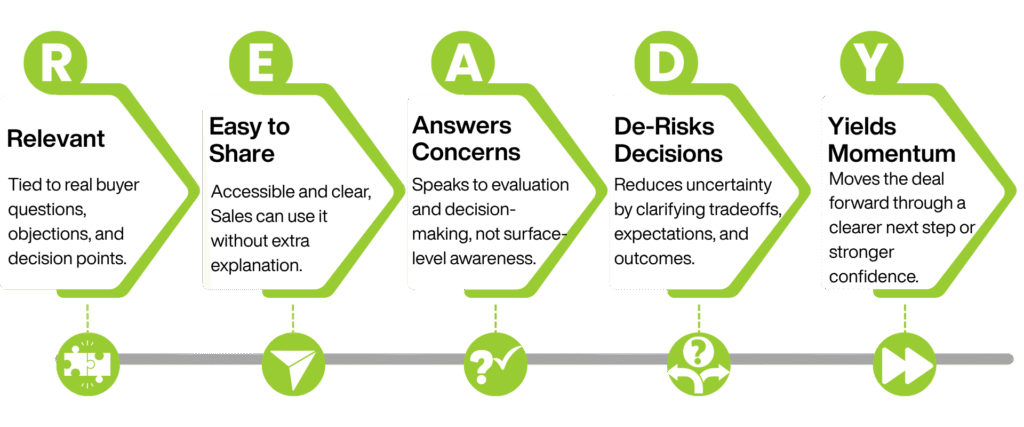
Run every asset against these five:
- Relevant. Is it tied to real buyer questions and objections?
- Easy to share. Can a rep send it with no friction, no hunting, and no logging into a system they never open?
- Answers. Does it speak to a buying decision instead of general awareness?
- De-risks. Does it lower the perceived risk of the purchase?
- Yields momentum. Does it move the deal to a clearer next step?
An asset that fails these is not ready to hand to sales.
What It Looks Like When It Works
One of our clients works through a network of independent insurance agencies across the country. Those agents are experts in risk management and education areas that go well beyond insurance, and all of that expertise was locked inside individual conversations.
“What this does for us is it takes the expertise of that network of independent agencies and it gives a vehicle for sharing it that then they can be in anyone’s office or anybody’s car or wherever they would need to be with just the sending of a link. It bottles up their expertise. And then we’re able to say to our internal teams, to our other agents, we got a great resource for you.”
The marketing team and the sales team built that catalog together, which is what makes “look what we did” possible. The part I like most is the queue. Their agents line up to be on the show, because they know the expertise they share gets used in the sales process.
To Wrap This Up
Sales protects what they own. Ask for their words, build with their fingerprints, return the work with their name on it, and your content stops getting ignored.
What is the one objection your sales team hears every week that your content has never answered? Start there.
If you want the interview questions handed to you, the POET framework question generator will produce them from content you already have at contentmonsta.com/poet. And if you want the full framework for building a revenue team that communicates, aligns, shares systems, and stays honest about its goals, my book CASH is at aleejudge.com/cash.